
The Norman Conquest of England in 1066
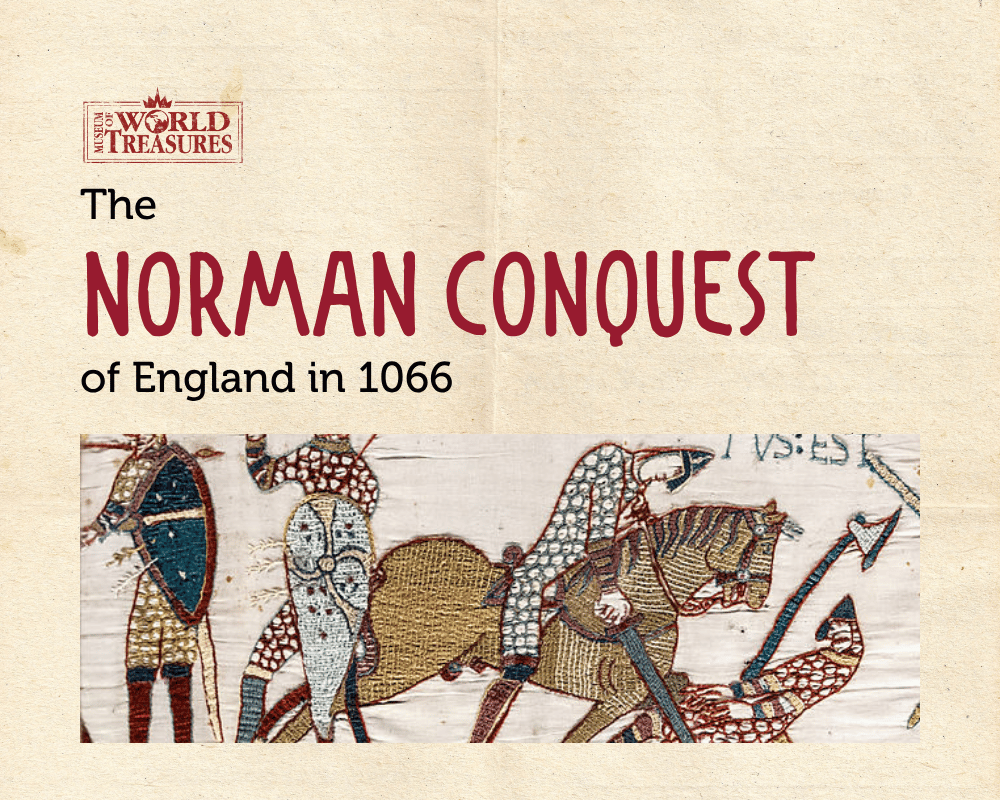
What was the Norman Conquest?
The Norman Conquest of England was an invasion led by Duke William of Normandy (also known as William the Conqueror) in 1066. He led this invasion after having been named as heir by King Edward the Confessor in 1051.
Conquering England and fighting off various Germanic forces is expensive, so, if you like what we are doing here you can support the Museum here. You can also follow us on Facebook and Instagram. Or you can join our mailing list below!
Many Claims, Many Problems
Because of his lack of a direct heir, King Edward of England promised his throne to a few different people, and a few others had different claims to the throne. Along with promising William the throne, he also promised it to Harold Godwinson, the Earl of Wessex. Tostig, Harold’s brother, and the King of Norway Harald Hardraada also both had legitimate claims to the English throne, and threatened invasion as well. On his deathbed in January 1066, Edward named Harold Godwinsson as his successor, and he was crowned king the following day. But in 1064, two years prior, Harold had sworn under oath in William’s presence to protect and defend William’s claim to the throne. Nonetheless, he still became king, thus angering William.
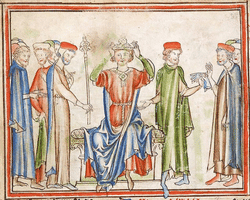
“The Life of King Edward the Confessor,” Anonymous, 13th Century, now housed in the Cambridge University Library
This image depicts Harold Godwinson at his coronation, placing the crown on his own head.
Harold’s Challenges
From essentially the beginning of his reign, Harold faced many difficulties. Tostig, who had been exiled and stripped of his earldom by Harold previously, began raiding England’s southern and eastern coasts in May, proceeding to join forces with King Harald of Norway. Harold kept his military posted over the summer, but eventually dismissed them after running out of supplies in September. This left the southern border without any defenses, which exposed it to William.
The Battle of Stamford Bridge
Before William could invade England from the south, however, Harald and Tostig invaded in the north. King Harold quickly gathered troops and left to Yorkshire, where Norway’s soldiers were at due to a previous battle with the earls of Northumbria and Mercia, which was won by Norway. Harold’s army caught them off-guard in a surprise attack, and at Stamford Bridge, Harold won a huge victory over Harald and Tostig in which they both were killed on September 25th, 1066.
William Gathers Support and the Battle of Hastings
Meanwhile, back in France, Duke William had secured support from the necessary aristocrats in France and the papacy in Rome to proceed with invasion. By August of 1066, he had assembled an army of between 4,000 and 7,000 knights and foot-soldiers. However, bad winds prevented him from sailing the English Channel.
Harold knew that while he was up north, William would take this chance to invade, and he had prepared to face it. However, he had troubles with keeping his forces together. The English soldiers had been out in the field for over three months already, and they needed to return home to their farms to help with the harvest. On September 27th, while Harold and his forces were still recovering from the previous battle, and after the army had disbanded, the winds changed, allowing William to cross the channel immediately. He landed in Pevensey, England, and moved directly to Hastings. Harold hurried south while gathering men, and he arrived eight miles north of Hastings on October 13th. William conducted a surprise attack on Harold the next morning, so Harold drew his army up onto a hill ridge.
William’s forces consisted of Normans, Bretons, French, and Flemish, with archers and crossbowmen in front of them and calvary behind. Harold equipped his soldiers with axes, spears, swords, slingshots, chain mail, javelins, and hammers, with other soldiers forming a shield wall. Harold’s highly trained wall held strong against William’s assault, which failed to breach the English lines. The Normans first shot arrows at the Anglo-Saxons, to which they responded with throwing their stone axes at the opposition while they tried to climb the hill. Next, the Norman calvary was sent in. However, they also struggled with the hill, and were pushed back by the English shield wall.
The Turning Point
Up until this point, the English were at the advantage. However, a rumor that William had been killed spread quickly amongst the Normans, and they began to flee. Some of the Anglo-Saxons were encouraged by this retreat, and began to chase after them down the hill. Once they reached lower ground, their formation had been lost, and William -- who was very much alive --sent his calvary after them. Because of the success of this accidental retreat, he ordered two more fake charges and retreats, both of which lured more and more of the Englishmen down the hill.
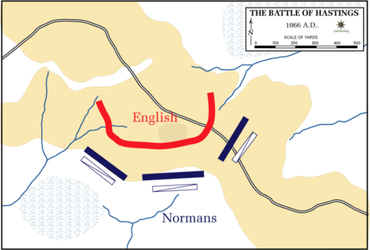
“Battle of Hastings, 1066: Battle Dispositions” - Department of History, United States Military Academy, August 23rd, 2014
This image shows the formation of both Harold and William’s armies at the Battle of Hastings
The End for the Anglo-Saxons
The battle had gone on for several hours, which was a considerable amount of time for a medieval battle. But the Normans were slowly winning. The Anglo-Saxons had been reduced, and there were not enough men to defend the ridge. In the final charge, Harold and other leaders, including his two brothers Gurth and Leofwine were killed. It is said that Harold’s death was caused by an arrow to the eye, after which he was hacked to bits by the Normans while laying defenseless on the ground. The remaining English soldiers retreated to another hill, but they were wiped out, after which victory belonged to William.
William the Conqueror later built an abbey on the site, called Battle Abbey, in order to thank God for his success. Harold’s body has never been found, despite the fact that a story from the 12th century states that his remains were removed from their burial near the battle site to Waltham Abbey. This abbey was searched and the tomb was found empty.
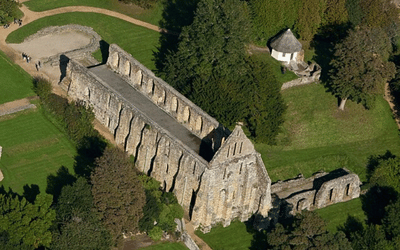
“Battle Abbey Dorter, Battle, Sussex, England” - Barbara van Cleve, October 6, 2014
This photo shows the ruins of Battle Abbey, as seen from above.
The Aftermath
William the conqueror was crowned as King William I of England on December 25th, 1066, which brought an end to 500 years of Saxon rule. However, William did face struggles for the next five years, facing rebels and building castle fortifications in response everywhere.
One of the primary sources for the Battle of Hastings is the Bayeux Tapestry, which was made between 1067 and 1079, stretching nearly 223 feet (68 meters) in length. It depicts in detail the events leading up to the Norman Conquest and the Conquest itself. However, it is considered a propaganda piece, as it reinforces William’s claim to the throne and omits quite a few pieces of information, such as the Battle of Stamford Bridge.
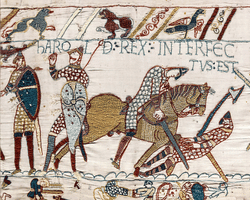
“The Bayeux Tapestry – Scene 57: The Death of King Harold at the Battle of Hastings”
This image from the Bayeux Tapestry depicts the death of King Harold at the Battle of Hastings. He is the man in red chain mail holding a shield in the left hand, and pulling at an arrow near his head with his right hand.
Because the Anglo-Saxons and the Vikings were defeated in 1066, a new era began, and the Normans replaced the Anglo-Saxons as the ruling class, as William redistributed land to his Norman nobles. The church was also restructured, and England gained closer relationships with continental Europe, especially France.
The Impact
William ended up reigning for about twenty years, dying in September of 1087. His reign laid the foundation for the English monarchy and the feudal system, as well as the integration of Norman culture into the English society. This influenced language, architecture, and government. Here are a few specific examples of how the conquest changed England:
- The Anglo-Saxon elite was almost completely replaced by Normans.
- The government became much more centralized, and wealth and power were in fewer hands.
- Anglo-Saxon bishops were replaced by Norman ones.
- Feudalism developed as William gave out land in exchange for military service.
- The English language adapted hundreds of French words and syntax, forever changing the language.
- France and England became intertwined in ways that would continue well into the modern day, primarily because Norman nobles held land in both countries.
It is clear that the Norman Conquest created a lasting change in the history of England, and it is interesting to think of where our society would be if things had gone a little differently on that fateful day so long ago.
