
Graffiti: One of the Oldest Forms of Art
What is Graffiti?
When you think of graffiti you may think of spray paint on passing trains or tags over street signs around town, but this art form has existed long before our modern infrastructure. Now you may be wondering, what makes graffiti different from other types of outdoor art? According to Merriam Webster graffiti is defined as, “usually unauthorized marking (as of words, symbols, or images) on a public surface (such as building, bridge, train car, etc.).” The unauthorized characteristic of graffiti places the earliest instances of it in ancient Egypt, Greece, and Rome. This is because legal systems were in place to authorize (or, alternatively punish) artists who marked public spaces.
Graffiti and street art decorates some of our items at the museum and preserving it is hard work. So if you like what we are doing you can support the Museum here. You can also follow us on Facebook and Instagram. Or you can join our mailing list below!
Ancient Graffiti
The graffiti found in ancient Greece and Rome is strikingly similar to the graffiti we see today. These inscriptions, etchings, and paintings often included funny, political, and even lewd jokes. For the archaeologists and historians these artworks give significant insight into the day-to-day thoughts of ordinary people. For example, Pompeiian graffiti included satire of individuals up for election, market day announcements, as well as petty gossip and crude likenesses of public figures. As stated by the Smithsonian Magazine, the graffiti of the ancient world was in many ways comparable to social media in terms of what information can be derived from it.
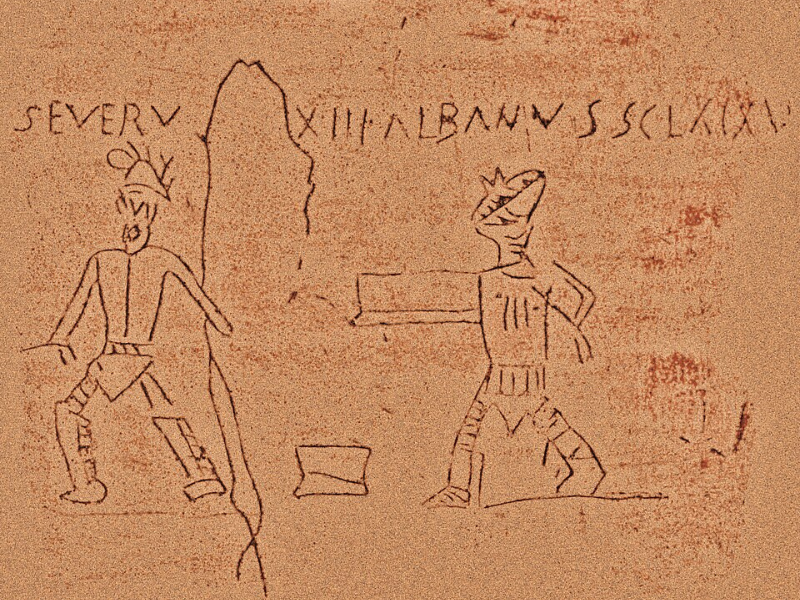
By Mediatus, Scan eines mir vorliegenden Abgusses. - Own work, CC BY-SA 3.0, https://commons.wikimedia.org/w/index.php?curid=9401377
This graffito is from a wall in the ancient Roman city of Pompeii, and it depicts two popular gladiators. (Note: graffito is the singular of graffiti in an archaeological context).
Medieval Graffiti
Graffiti in the medieval period looked very different, but often serves a similar function for contemporary researchers. For medieval Europe, archaeologists and historians often focus on the unofficial inscriptions on church walls. However, medieval graffiti at large can be categorized into ship graffiti, merchant’s marks, heraldic and devotional graffiti, and more.[1] Graffiti has also aided in the preservation of ancient languages, especially local dialects. One of the only sources of the Safaitic language is in graffiti, and the discovery of this served to enhance the historical knowledge of ancient Arabic language forms. By looking at medieval graffiti researchers get a unique glimpse into subcultural groups and functional belief in the lives of common people.
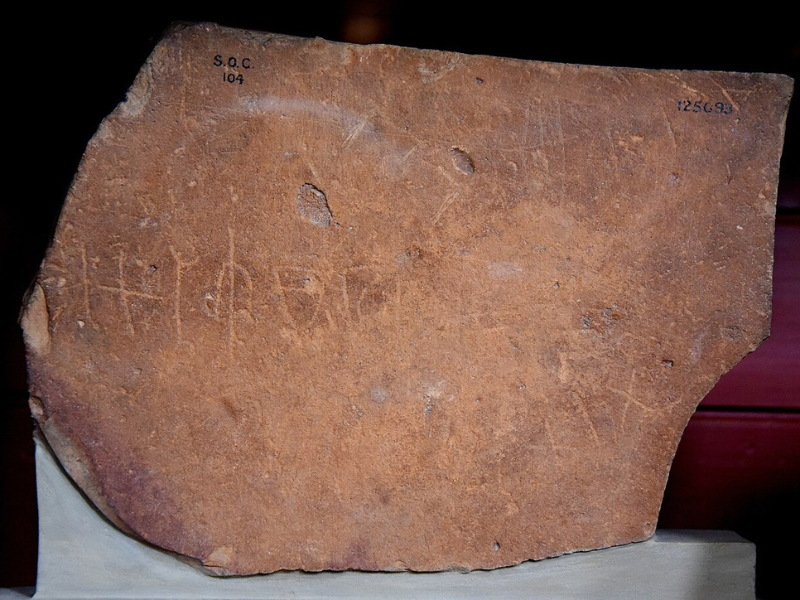
One of the few examples of Safaitic writing is housed at The British Museum in London, England.
19th Century Graffiti
Graffiti became a major source of public outcry in France from the end of Franco-Prussian War to the beginning of the Third Republic. This serves as an example of hyper-political graffiti, and it common as it was accessible to people from any socioeconomic class. As a result of the diverse range of artists the images, slogans, and symbols were equally as variable. From vulgar and humorous quips like “Long live Crapoleon!” to a nearly illegible “I’m hungry,” the street art of late 19th century Paris told a story of conflict, turmoil, and polarization.[2] This was illegal to do, and punishable by law—a trend in graffiti that has persisted to the current day in most places around the world.
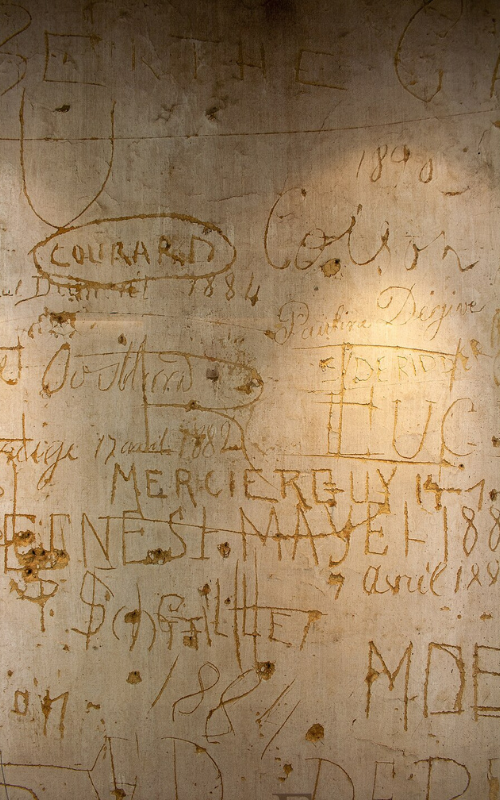
By Szilas - Own work, CC BY 4.0, https://commons.wikimedia.org/w/index.php?curid=142973123
19th century French graffiti could be found outside of Paris as well, such as this example from Bouillon Castle in Belgium.
Modern and Post-Modern Graffiti
Some of the most famous graffiti of the modern era is that which decorated the Berlin Wall. Built in 1961, the people of both West and East Germany painted and etched their feelings, fears, and desires into the wall over the course of its life. Graffiti exists on both sides of the wall, however the German Democratic Republic (GDR; East Germany) would punish the artists they caught violently. There is a piece of the Berlin Wall here at the Museum of World Treasures that has graffiti on the East side. This brave artist painted a hole boring through from the West like a bullet through metal. Through the gap there is a kite, depicting the freedom they desire on the other side.
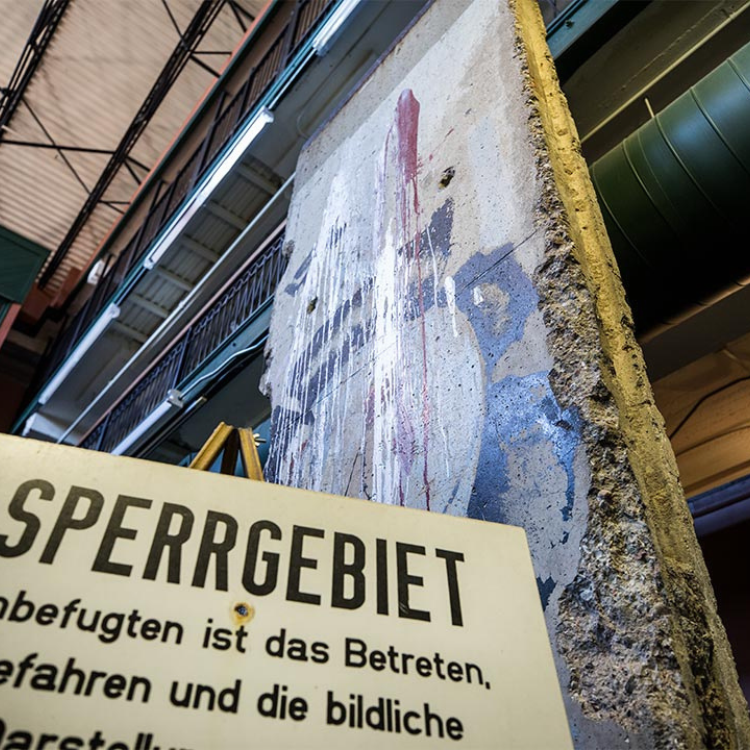
The Museum of World Treasures displays this section of the Berlin Wall in partnership with the American Overseas Schools Historical Society (AOSHS).
From local politics, to jokes, to warfare, graffiti has been the artistic vessel for human expression around the world for centuries. But what about graffiti today? Much the same, the graffiti you see around your home, school, work, or just around town is an expression of urban experiences. Since the mid-20th century graffiti has been regarded as a sign of criminality and low-income neighborhoods. This is likely because the modern scene emerged in places like East Harlem in the 1960s, which faced institutionalized racism and municipal neglect. However, many anthropologists, historians, and artists agree that this artform is a crucial cultural artifact that teaches us about individuals and communities that feel their perspectives are not widely understood. There have been several initiatives by museums, galleries, and governmental bodies to recognize the validity of the artform in recent years. By preserving and analyzing graffiti we can learn more about people, our communities, and ourselves.

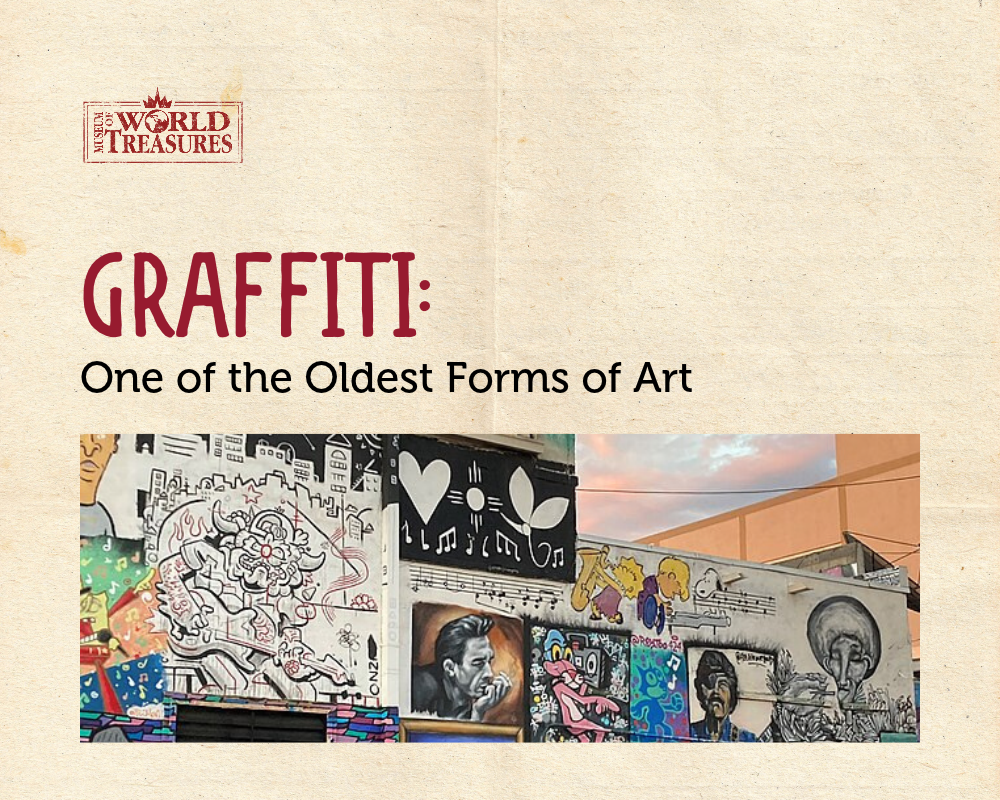
A wall in Albuquerque, New Mexico covered in new-age graffiti, likely in collaboration with local businesses.
[1] Jacob Scott, “A Consensus of Symbols: Medieval & Historic Graffiti in the Medieval Buildings of Kent,” Kent Archaeological Society, January 19, 2025, https://www.kentarchaeology.org.uk/magazine/120/11-a-consensus-of-symbols.
[2] Matthew Wills, “Graffiti: Jaytalking in 19th Century Paris,” JSTOR Daily, December 3, 2025, https://daily.jstor.org/graffiti-jaytalking-in-19th-century-paris/.
