
When in Rome: Greco-Roman Education
In the ancient Roman Republic and later Roman Empire, Greek culture played a crucial role in Roman language and education. As Rome grew, it absorbed elements from many different cultures, and Greece was perhaps the most influential. The Romans knew that the Greek language was important in order to secure other territories, as many of the Mediterranean and Oriental areas had already been under Greek control for centuries, and had communicated with each other in Greek. The Greek language ended up becoming essential to the development of Roman education and later, even Roman literature.
Before we discuss Latin philology and language spreads, if you like what we are doing here you can support the Museum here. You can also follow us on Facebook and Instagram. Or you can join our mailing list below!
Background: Magna Graecia and the Macedonian Wars
The Macedonian Wars were a series of four major conflicts between the up-and-coming Roman Republic and the kingdom of Macedonia, which lasted between 215 BCE and 146 BCE. These wars created more interaction and involvement between the Romans and Greeks, and eventually helped Rome conquer the whole of the Mediterranean. The quickly growing Roman state conquered and annexed Macedonia in 168 BCE, Greece Proper in 148 BCE, the Hellenized Orient (which had been under Greek control ever since it was conquered by Alexander the Great many centuries before), and lastly, the Greek kingdom of Pergamum in Anatolia in 133 BCE.
However, as I have written in previous posts, the Greeks had already been in contact with the Romans long before the Macedonian Wars occurred. Before this, the Greeks had colonies in southern Italy called Magna Graecia, where they traded and communicated with the Etruscan, Oscan, and Latin tribes of middle and northern Italy. Thus, there had been some exposure to each culture and language long before the Romans fully conquered Greece in 146 BCE. These new Roman territories created an influx of Greek culture in Rome, particularly of literature, art, and language.
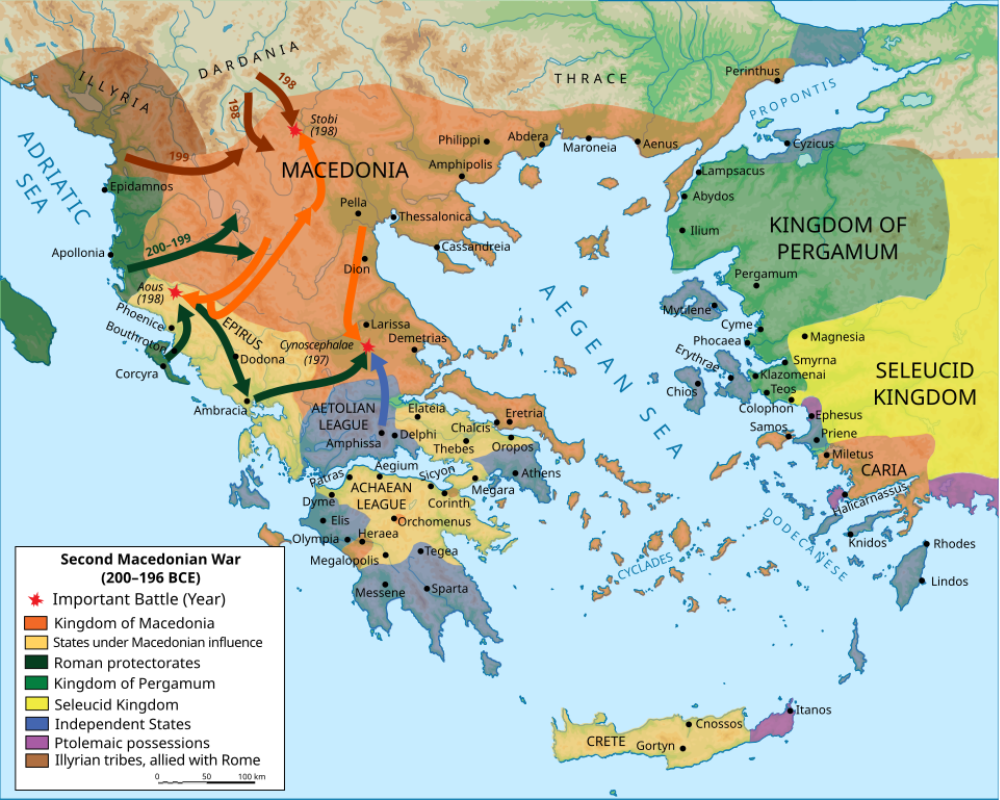
Second Macedonian War (200 to 196 BC), Pasztilla Terbocs, February 4th, 2021
This map shows the Second Macedonian War, when Macedon fought Rome, and was thus conquered.
The Greek Language in Rome
Typically, when a governing body is in charge of an area that is not originally their own, their languages, among other things, begin to influence each other, and Roman conquered Greece is no exception. In the broad perspective, Greek did influence Latin, but not really the other way around. Latin borrowed many words from Greek, and in fact, modern English gets our Greek roots through Latin—words that begin with the prefixes photo or auto—for example. In addition to this, the Latin alphabet was a borrowed early Greek alphabet that the Romans had taken from the Etruscans, who borrowed it from the Greek settlement of Cumae.
The reason that Greek doesn’t have as many borrowed words from Latin as Latin does Greek is because the Romans, particularly the elite and wealthy, treated Greek as a prestigious language and were therefore willing to learn it, so the Greeks didn’t feel the need to learn much Latin.
After the Romans conquered the whole of Greece, many Greeks began to live and work in Rome, of which the majority were there as educated slaves that had been brought in to teach Greek to the Roman upper (and some middle) class children.
In addition, the Romans realized that learning and using Greek would be important for them due to the fact that their new subjects only knew Greek. Therefore, Greek was the language used for documents that were intended to be read in the Greek settlements, including items such as proclamations or letters from the emperor to the magistrates. Besides this, the Greeks also had something else that Roman leaders realized would be crucial, and that was the art of rhetoric, which was important to persuade civilians to trust their new Roman governors, and therefore establish peace in their new territories.
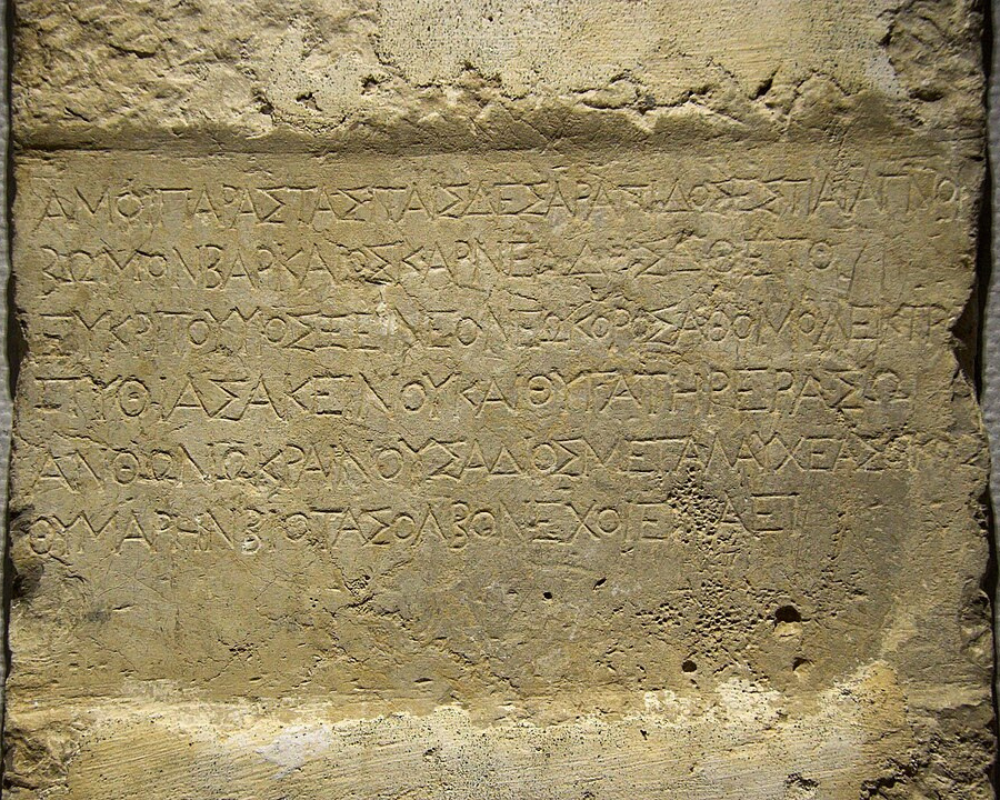
Dedication of Altar to Hestia from Karneades, Taormina, Italy, picture uploaded on September 20th, 2012
This picture shows an inscription of an altar to Hestia (the Greek goddess of the hearth) found in Sicily, Italy.
Hellenistic Education in Rome
Because Romans realized the importance of the Greek language and rhetoric, the wealthy citizens employed Greek slaves or servants to teach their children. However, only children of this aristocratic upper class had the privilege of learning the complete and bilingual education. The child, either boy or girl, was taught by their household’s Greek tutor, and thus learned to speak Greek fluently, sometimes even before they could speak Latin fluently. The student also learned how to read and write in both Greek and Latin, with Greek again being taught first.
The early Roman schooling system essentially copied the Greek education system, including the discipline, the scientific method, the alphabet, the syllabary, and then finally, the method for writing (for example, how books/texts were written and read). There were three levels of education in ancient Rome, similar to our modern schooling system. These levels were the same as the Greek counterpart and were called ludus, grammatikos, and rhetor, and at all three levels, the students were taught by a Greek teacher.
The first level was called ludus and similar to modern elementary school, a student was taught basic reading, writing, and arithmetic. This level set the groundwork for further learning.
The second level was called grammatikos, and was similar to modern middle school levels of learning. The students were taught literature, grammar, history, and mythology, thus learning how to engage with the cultural and intellectual traditions of Rome.
The last level was called rhetor. This was the advanced stage where the student focused on rhetoric, which is the skill of using writing and speaking to be persuasive. This level was essential if the student wanted to gain skills and abilities that would allow them to have careers in politics, law, or public service.
After these three fundamental levels, if a student wished for more complete study or simply more education, then they may have left Rome for a time, traveling to Greece to participate in studies conducted and taught by Greek teachers. From 119/118 BCE onwards, these young Romans more than likely attended the Ephebic College in Athens, and by the first century BC, students such as Cicero were attending the schools of the best philosophers and rhetoricians in Athens and Rhodes.
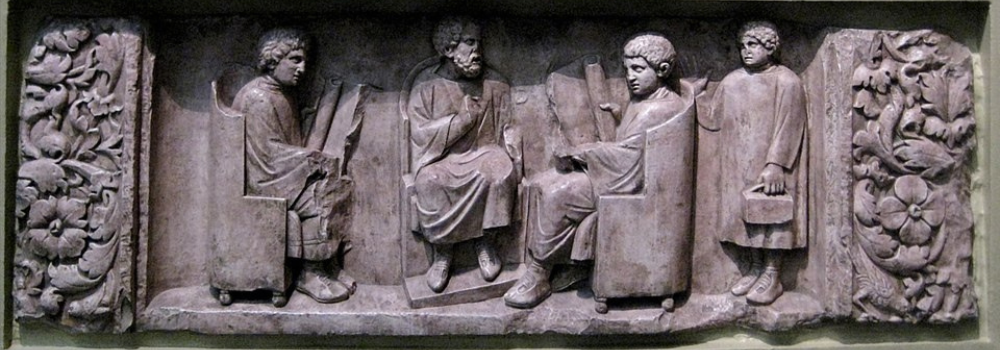
A teacher with three discipuli, relief found in Nuemagen near Trier, circa 180-185 CE, uploaded April 2013
This casting of a real relief depicts a teacher instructing three students and was found in a town near the edge of the empire’s borders.
Public Education in Ancient Rome
Eventually, social pressure brought about a gradual development of public education in Rome. These schools basically taught and ran the same as private schools, and included the same levels, however these students were taught in Latin, not Greek. After a while, Greek tutelage did make its way into public schools, but the students were not trained as well as the privately educated aristocrats, and certainly were not taught as much or in as much detail. Nevertheless, public schooling was a good option for middle- and lower-income students. However, the wealthy and aristocratic children remained attached to in-home private school. The levels of education in public schools corresponded to the private schools, with ludus, grammatikos, and rhetor.
The ludus level was almost exactly the same in the public schools as in the homes of wealthy children, albeit taught in Latin. The grammatikos level, however, varied slightly, as they were staffed by Roman educators called Grammaticus Latinus. It also did not go into as much detail of Roman tradition as the private schools did. The main subject of this education level was poetry and its analyzation, but its spread was slowed by the deceleration at which Latin literature developed, which will be discussed in a following post. Students of the grammatikos level used grammar textbooks to study language and composition, except it was still rather basic compared to the private Greek education.
Even though original Latin literature slowed around this time, it did not lose its stability fully, and people still produced many works of literature and poetry. However, it was not until the Augustan Age (43 BCE – 18 CE) that these works became widespread enough to be studied and analyzed. This era produced poets that could be considered the Latin equivalent of Homer in terms of educational value. Authors like Sallust, Virgil, Cicero, and Terence created many works of literature that rivaled Greek ones. Cicero also translated Greek works into Latin. These authors allowed middle- and lower-income students to have access to great works written in their native tongue, and therefore experience a much wider world than they might have known without them.
The third level, rhetor, was not established publicly in Latin until the 1st century BCE. The first Latin rhetorician was Plotius Gallus, who appeared in 93 BCE, and was a politician who argued for a public and Latin education. However, it was not until the end of this century, with the works of the aforementioned authors appearing, that this level of education in Latin would become normal among Roman citizens. This was because their discourses, theses, and writings—particularly those of Cicero—provided Latin students an advanced vocabulary which ended up rendering the Greek texts essentially unnecessary.
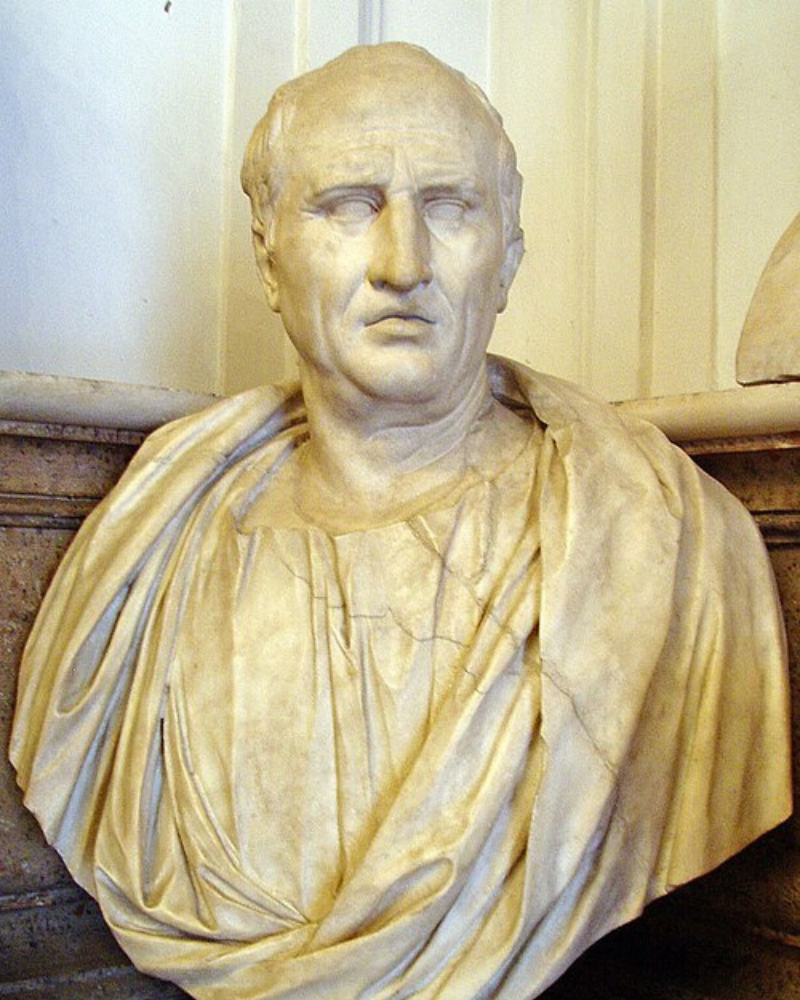
Bust of Cicero, Musei Capitolini, Rome, 1st half of 1st century CE
This bust depicts Cicero, who was a great writer, orator, and lawyer. He wrote many treatises on rhetoric, politics, and philosophy. He had been educated in Greece and Rome.
The Greek language and education system played a huge role in the education and language of Roman citizens. It affected the way Romans learned, and what they thought of as important knowledge to teach and learn. Even to this day, their languages and ways of learning can be seen in our society.
